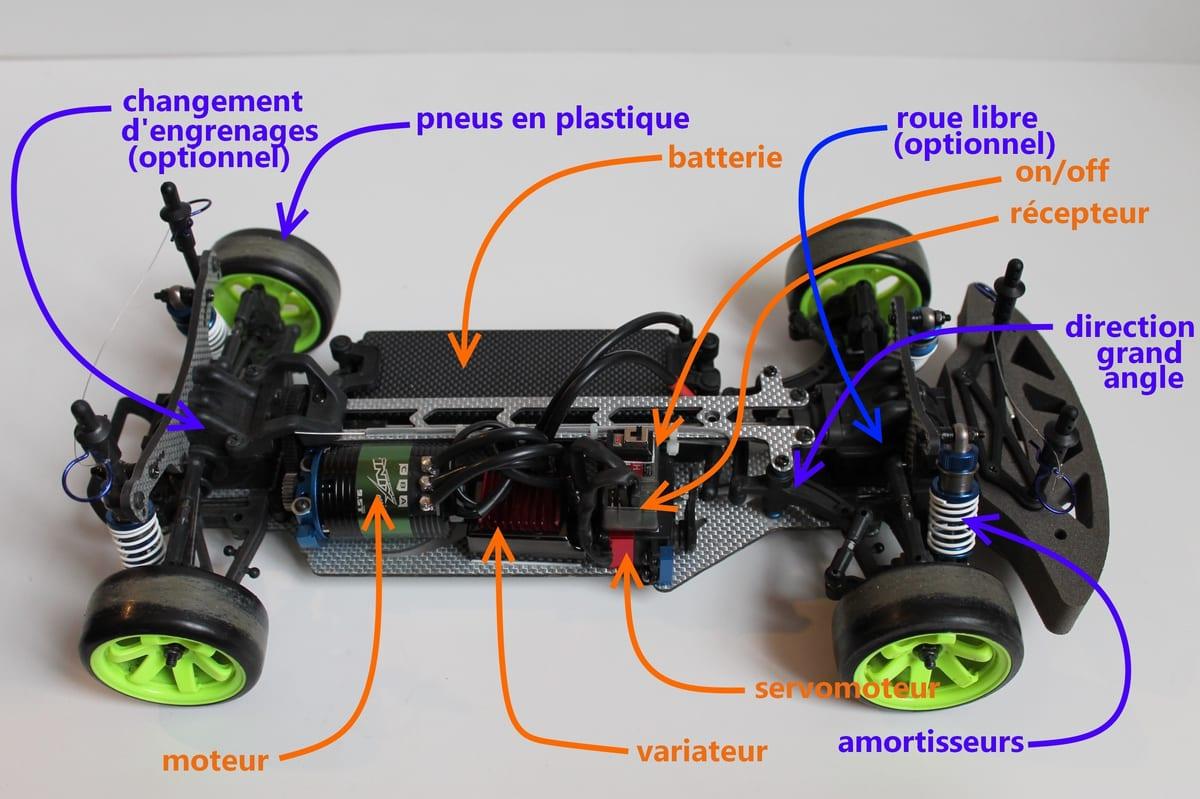
Broke an RC Car Part? Get Custom RC Parts Printed
The front left A-arm snapped on a jump landing. You look up the part number, and the hobby shop tells you the kit went out of production years ago. The manufacturer's parts page returns a dead link, the only used pairs listed are overseas and second-hand, and the car is otherwise perfect.
This is the normal end-state for hobby-grade RC. Chassis outlive their parts support by a decade. The good news is that suspension and mounting hardware is exactly the category that 3D printing handles well, as long as you ask for the right material and accept that some parts genuinely should not be printed.
Can you 3D print RC car parts, and what do they cost?
Yes. Suspension arms, bumpers, skid plates, body mounts and battery trays all print successfully in nylon or PETG, and cost $12–60 per part commissioned, or $60–120 for a full nylon suspension set on an SLS machine. Add a one-time $40–90 design fee if the part must be modelled from your broken original. Gears and driveshafts should still be bought.
Last verified: July 2026
Key takeaways
- •Nylon (PA12 or PA6-CF) is the correct material for RC suspension parts. It yields and returns instead of shattering, which is the failure mode that matters on impact.
- •PLA has a heat deflection temperature around 55 °C. Asphalt in direct summer sun regularly exceeds that, so a PLA part can soften while the car is simply sitting on the track.
- •A commissioned printed RC part costs $12–60, or $60–120 for a full nylon suspension set on an SLS machine. Modelling from a broken original adds $40–90 once, after which reprints are cheap.
- •Printed spur gears and pinions strip under brushless torque. Buy those; the $6 you save is not worth a stripped diff.
- •Printed parts are usually fine for bashing and scale classes and usually illegal in sanctioned spec racing. Check before the event.
Which RC Parts Print Well, and Which Ones Don't
The dividing line is not size or complexity. It is whether the part carries concentrated rotational load through small teeth. Anything that spreads load over a broad plastic section prints well. Anything that transmits motor torque through a few square millimetres of tooth face does not.
| Part | Print it? | Notes |
|---|---|---|
| Suspension arms, hubs, steering knuckles | Yes, in nylon | Print the arm flat on the bed, in the plane it occupies on the car, so the layer planes lie parallel to the suspension load path instead of stacking across it. An A-arm's working loads — braking, cornering and the bending of a landing — all act in that plane, and standing the arm on edge would put a layer boundary square across every one of them. The layer boundary is where an FDM part is weakest. Nylon arms are often tougher than the stock injection-moulded part. |
| Bumpers, skid plates, body posts | Yes, PETG or TPU | These are sacrificial by design. TPU 95A bumpers absorb hits and spring back rather than transmitting the shock into the chassis. |
| Servo mounts, motor mounts, battery trays | Yes, PETG or nylon | Watch heat near a brushless motor can. Use nylon or ASA within about 30mm of the motor, PETG elsewhere. |
| Radio boxes, gear covers, scale accessories | Yes, anything | Zero structural load. This is the cheapest category to print and the easiest to customise while you are at it. |
| Shock towers, chassis braces | Marginal | Printable in PA6-CF, but the stock part is usually aluminium or fibre-reinforced for a reason. Treat a printed one as a get-you-home part. |
| Spur gears, pinions, diff internals | No | A printed tooth is a few perimeters wrapped around infill, and it wears and shears under brushless torque long before the rest of the gear gives up. The debris ends up inside the diff. These are $5–15 parts that are still made. |
| Driveshafts, hinge pins, bearings | No | Metal parts, metal replacements. Universal driveshafts are commodity items in standard lengths even for dead chassis. |
Why PLA Is the Wrong Answer for an RC Car
PLA is the default material on almost every hobby printer, and it is the reason most people conclude that printed RC parts don't work. It fails two ways on a car.
First, heat. Published technical data sheets put PLA's heat deflection temperature at roughly 55 °C at 0.45 MPa. Sunlit asphalt runs far hotter than that: a 2023 Journal of Burn Care & Research study measuring sunlight-exposed surfaces in Las Vegas recorded asphalt peaking at 74 °C, and the inside of a closed car boot is worse. A PLA battery tray can sag while the car is parked, before it has taken a single hit.
Second, impact. PLA is stiff and notch-sensitive: it takes load right up to the point where it shatters into two clean pieces. Nylon and TPU deform, absorb the energy, and usually return to shape. That difference is the whole ballgame on a vehicle whose job description includes hitting things.
Heat deflection temperature by filament, 0.45 MPa
PLA softens around 55 °C, well inside the range of real summer asphalt surface temperatures, which peak near 74 °C. PETG at 68 °C clears PLA comfortably but not that peak; ABS, ASA and nylon are the ones with real margin against it, which is why they are the sensible defaults for parts that live outdoors on a car. Read PA6-CF's 186 °C as a heat-deflection figure only: its glass transition is around 68 °C, so it will still creep under sustained load long before it reaches its HDT.
| material | Heat deflection temp (°C) |
|---|---|
| PLA | 55°C |
| PETG | 68°C |
| ABS | 100°C |
| ASA | 93°C |
| PA6-CF nylon | 186°C |
Source: Manufacturer technical data sheets at 0.45 MPa: Prusament PLA (55 °C), PETG (68 °C) and ASA (93 °C); Polymaker PolyLite ABS (100 °C); Bambu Lab PA6-CF (186 °C). Compiled July 2026
If you only remember one line from this post: ask for nylon on anything in the suspension, and accept PETG everywhere else. PA12 printed on an SLS machine is the premium option and is genuinely excellent, with near-isotropic strength: SLS parts still give up something in the build direction, but on the order of 10–20% rather than the far larger penalty FDM pays across its layer lines. FDM nylon is cheaper and still far better than PLA, provided the maker dries the filament properly. Ask them whether they do; the ones who take nylon seriously will answer immediately.
What a Printed RC Part Costs
Most RC parts weigh between 5g and 40g, so material is almost never the cost. A pair of 1/10-scale front arms is roughly 20g of filament, about $0.60 of PETG. What you are paying for is machine time, the maker's setup and, on a first order, the CAD work.
Typical commissioned cost by RC part type
Ranges are per order, assuming a usable model already exists. Modelling a part from your broken original adds $40–90 once, after which reprints of the same part cost only the print.
| part | Typical low | Typical high |
|---|---|---|
| Body post / light bucket | $12 | $25 |
| Bumper or skid plate | $20 | $45 |
| Suspension arms, PETG pair | $30 | $50 |
| Servo or motor mount | $25 | $55 |
| Battery tray / radio box | $25 | $60 |
| Nylon arm set, SLS | $60 | $120 |
Source: 3D Print Bounty maker quotes and comparable independent RC commissions, July 2026
One thing worth doing before you commission anything: check whether the part is actually gone. Some manufacturers keep spares listed for chassis that have been out of production for years, and classic kits do get re-released along with their parts trees. Check the manufacturer's own parts page and a couple of the larger hobby distributors before you assume it is unavailable. If a $9 OEM arm exists, buy the $9 OEM arm. Printing is for the genuinely dead: platforms whose maker has folded or been sold on, and every no-name brand that sold well for two seasons and vanished.
Where printing wins outright is quantity. Once a maker has the model, a set of four arms costs barely more than one, so you buy spares. That changes the economics of a car you actually drive hard: the reason people retire an old chassis is usually that the next break will be terminal, and a drawer of spares removes that.
How to Get a Dead Part Remade
The single most useful thing you can send is the broken part itself, both halves, unglued. A maker can reconstruct a clean model from two fragments far more easily than from a photograph of an intact one, because the fracture face shows the internal wall thicknesses.
| Send this | Why |
|---|---|
| Hinge-pin and screw hole diameters | These are the only dimensions that must be exact. Measure the pin itself with calipers, not the hole. Most 1/10 hinge pins are 2.5mm or 3mm. |
| Pivot-to-pivot centre distance | Gets the suspension geometry right. A 1mm error here changes camber and track width noticeably. |
| Chassis brand, model and year | Sometimes a community model already exists on Printables or Thingiverse, which removes the design fee entirely. |
| Photos with a steel rule in frame | Gives the maker a scale reference to sanity-check your measurements against. |
| How you drive it | Bashing, carpet racing and rock crawling produce completely different failure loads. A crawler arm can be thinner and more flexible; a basher arm should be solid and printed in nylon. |
The general workflow for measuring and documenting a broken part is the same across every category we handle, and it is covered in detail on our 3D printed replacement parts page.
When Printing Is the Wrong Call
Three situations where you should not bother. First, if the OEM part is still in stock for under about $15, buy it. Printing wins on availability and customisation, not on price against a manufacturer's injection-moulding run.
Second, if you race in a sanctioned spec class. Approved-parts rules exist in most organised touring and off-road classes, and a printed arm will get a car excluded at tech inspection regardless of how well it performs. Bashing, scale crawling and most club trail classes have no such restriction.
Third, if the part is a bearing seat under continuous rotational load with no metal insert. Printed plastic will wear oval. If you must print it, ask for a design with a press-fit metal bushing, which is a normal request and adds a couple of dollars.
Frequently asked questions
Can you 3D print RC car parts that actually hold up?
Yes, for suspension arms, bumpers, body mounts, skid plates, servo mounts, battery trays and radio boxes, provided they are printed in nylon or PETG rather than PLA. The exception is the drivetrain: printed spur gears, pinions and driveshafts strip or shear under brushless torque and are not worth attempting.
What material should RC car parts be printed in?
Nylon (PA12 or PA6-CF) for suspension arms, hubs and shock towers, because nylon bends and returns instead of shattering. PETG for bumpers, trays and mounts. TPU 95A where you want the part to absorb impact, such as body posts and front bumpers. Skip PLA: it passes the bench test and fails on the first hard landing.
How much does a 3D printed RC car part cost?
Expect $12–60 per part from an independent maker when a usable model already exists, plus $40–90 once if the part has to be modelled from your broken original. A body post or light bucket is at the bottom of that range; a pair of PETG front arms typically lands at $30–50, and a full nylon suspension set printed on an SLS machine runs $60–120.
Can someone copy my broken RC part if I have no STL file?
Yes. A maker measures the pieces with digital calipers and rebuilds the geometry in CAD. Send both halves of the break, photos against a ruler, and a photo of the part still fitted to the car. Budget two to five hours of modelling, which is where the one-time design fee comes from.
Are 3D printed parts legal in RC racing?
It depends entirely on the class. Club bashing, scale crawling and most trail classes allow anything you can bolt on. Sanctioned spec classes usually require parts from an approved list, so a printed arm can make an otherwise legal car ineligible. Check your club rules before a race weekend, not after.
Get Your Broken RC Part Remade
Post photos of the break with a ruler in frame, your chassis model, and how you drive it. Makers with nylon experience will bid, and your payment stays in escrow until you approve photos of the finished parts.