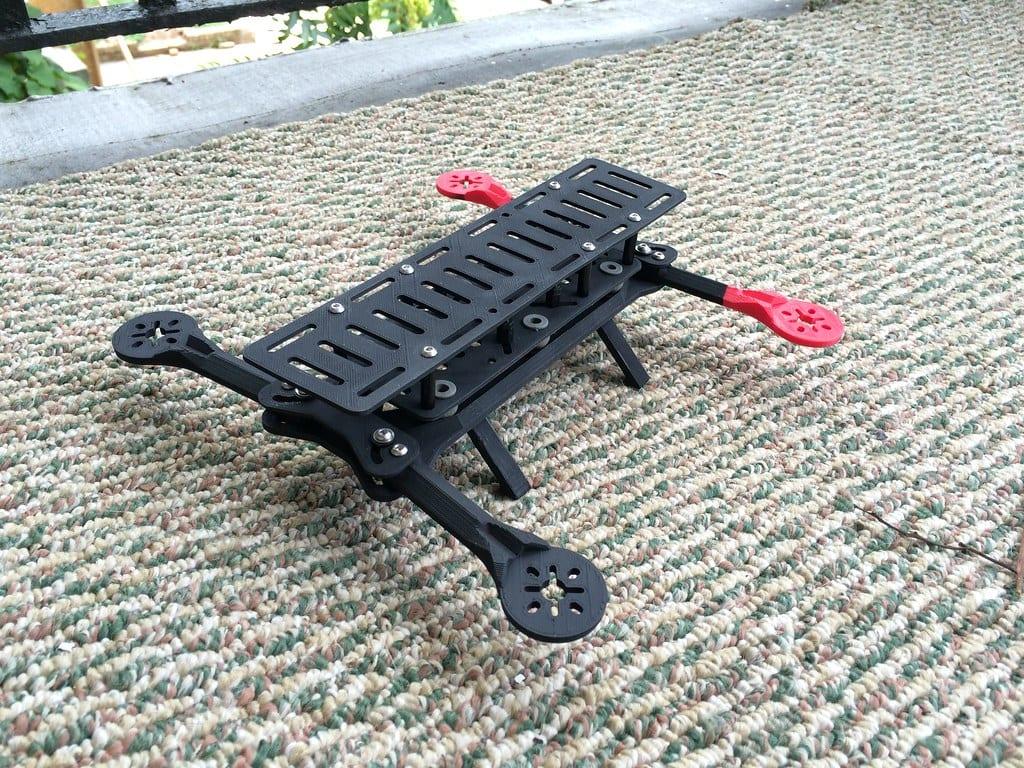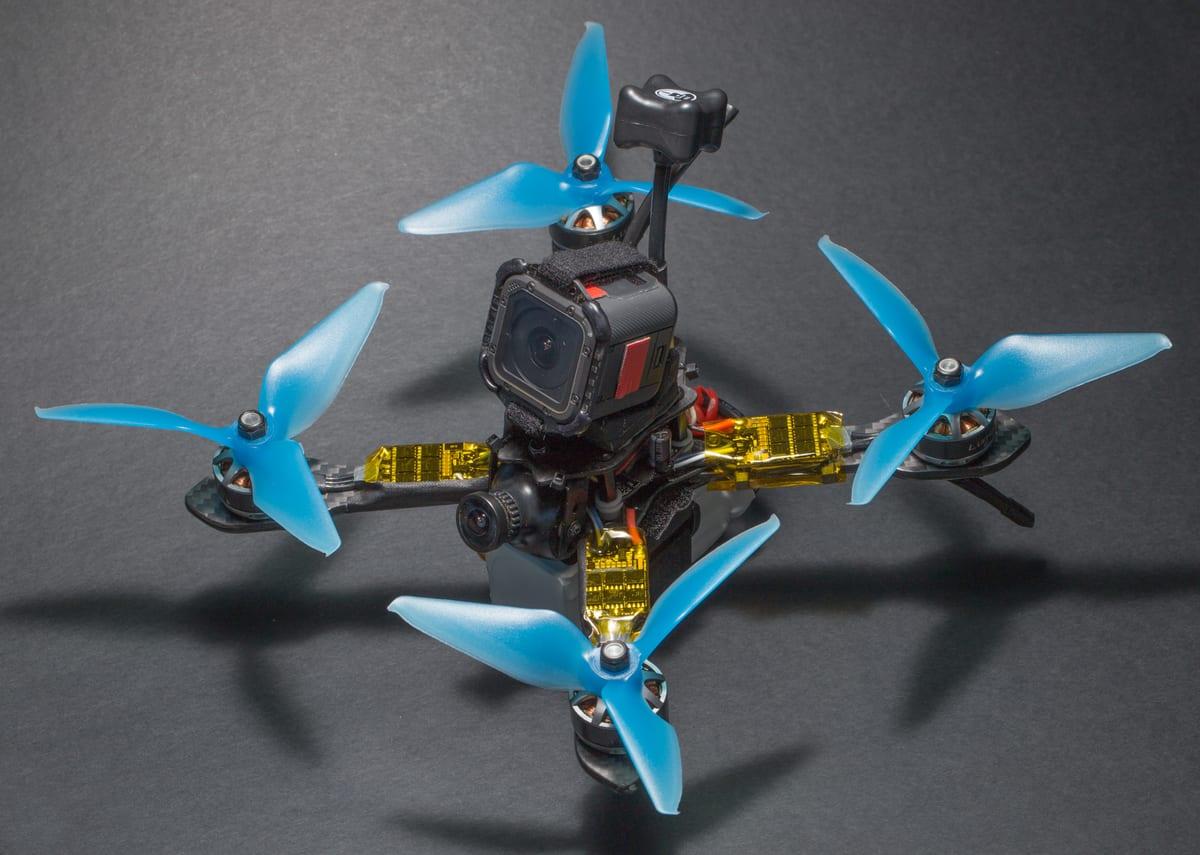
Custom 3D Printed Drone Frames: Specs and Cost
Every FPV build eventually produces the same moment. You break an antenna mount in a hedge, discover the replacement is $9 plus $12 shipping and three weeks out of stock, and think: this is a lump of plastic, surely somebody can print one. They can. The interesting question is how far up the airframe that logic holds before it stops being a good idea.
This is a guide to airframe design and material choice: which structure is sensible to print, which filaments survive being bolted next to a motor, what a commissioned frame actually costs, and where a printed airframe costs you more in grams than it saves you in dollars. If your aircraft is a factory-built consumer drone and the part you need is a discontinued cover, guard or mount, that is a different job — see our guide to 3D printed replacement drone parts.
Can you 3D print a drone frame, and what does it cost?
A printed airframe works for sub-250g quads, cinewhoop ducts and fixed-wing platforms. Expect $45–110 to commission a complete printed micro frame, $150–400 for a fixed-wing airframe, and $35–90 for ducts or a canopy. Matching a 3mm carbon arm's bending stiffness in PA-CF nylon costs 60–80% more mass, so buy carbon arms at 5-inch and up.
Last verified: July 2026
Key takeaways
- •PLA has a heat deflection temperature of 55 °C at 0.45 MPa. Motor bells, video transmitters and a dark airframe in direct sun all exceed that, so PLA does not belong on a flying airframe.
- •TPU 95A is the default for ducts, guards and anything sacrificial because it absorbs crash energy instead of transmitting it into the flight controller stack.
- •Matching the bending stiffness of a 3mm carbon arm in PA-CF nylon costs roughly 60–80% more mass, which is why printed arms are rare at 5-inch and above.
- •Heat deflection is not glass transition. PA6-CF has a 186 °C HDT and a Tg around 68 °C, so a printed structural bracket can creep under sustained load far below its HDT figure.
- •A commissioned printed micro frame runs $45–110 and a fixed-wing airframe $150–400; ducts, canopies and mounts sit between $15 and $90.
Where a Printed Airframe Wins and Where Carbon Does
The rule that holds up across build classes: print the structure that breaks, buy the structure that carries load. A duct or a canopy is effectively a consumable, and it is prop-size and stack-layout specific, which is exactly the combination a factory will never make for you. Printing it in a crash-absorbing material is a straight upgrade over a rigid injection-moulded part.
Arms are the opposite. An arm carries motor torque, thrust and every impact load, and its job is to be stiff. Frame stiffness is not a nice-to-have on a quad. Flex in an arm shows up as vibration at the gyro, and vibration the filter cannot remove becomes oscillation that no amount of PID tuning fixes.
| Part | Print or buy | Why |
|---|---|---|
| Camera and antenna mounts | Print, TPU 95A | Designed to deform on impact. TPU survives crashes that shatter injection-moulded nylon, and a replacement is 20 minutes of print time. |
| Cinewhoop ducts | Print, TPU or PA-CF | Ducts are large, geometrically fussy and prop-size specific. Almost nobody stocks the one you need for your exact motor spacing. |
| Prop guards and landing gear | Print, TPU 95A | Sacrificial by design. Printing them also lets you tune the wall count until they break before the arm does. |
| Canopy / top shell | Print, PA-CF or ASA | Cosmetic and aerodynamic rather than structural, and the part most often obsolete when you swap a VTX. |
| Arms and centre plates (5-inch and up) | Buy carbon | A 3mm carbon arm is stiffer per gram than anything an FDM printer produces. Flex here becomes gyro noise you cannot filter out. |
| Fixed-wing / mapping airframes | Print, PA-CF or LW-PLA | Low load per unit area, large volume, and no commercial equivalent for a one-off sensor payload. This is where printed airframes genuinely win. |
Why PLA Does Not Belong on an Airframe
PLA is the wrong material for anything structural or heat-adjacent on a flying aircraft, and the reason is a single number: its heat deflection temperature is 55 °C at 0.45 MPa. That sounds high until you look at where drone parts actually sit. A hard-working motor bell runs 60–80°C. An analogue video transmitter without airflow reaches similar temperatures within a couple of minutes on the bench. A black airframe on tarmac in July gets there on its own.
The failure mode is not dramatic. The part does not melt. It sags, the camera tilt creeps a few degrees between packs, and eventually a mount that was clamping a lens stops clamping it. That is worse than a clean break, because you spend three flights blaming the camera.
Heat deflection temperature by filament, 0.45 MPa
PLA deflects at 55 °C, below the operating temperature of motor bells and video transmitters. ASA, PC Blend and PA6-CF all clear anything a small airframe generates. Read PA6-CF's 186 °C carefully, though: heat deflection is not glass transition, and PA6-CF's Tg is around 68 °C, so a bracket under sustained load will creep well below its HDT.
| material | Heat deflection temp (°C) |
|---|---|
| PLA | 55°C |
| PETG | 68°C |
| ASA | 93°C |
| PC Blend | 113°C |
| PA6-CF nylon | 186°C |
Source: Manufacturer technical data sheets, heat deflection at 0.45 MPa: Prusament PLA, PETG and ASA; Prusament PC Blend; Bambu Lab PA6-CF. July 2026
In practice the choice is narrow. TPU 95A for anything sacrificial. PA-CF nylon for structural plates, canopies and arms on small builds: it is stiff, tough, and shrugs off heat, but it is hygroscopic enough that it must be printed straight from a dryer. Polycarbonate where you want maximum stiffness and impact resistance and can tolerate a fussy print. ASA when the part lives in the sun, because it is UV-stable in a way PETG is not.
PETG is the one honest middle ground. It is cheap, easy, and fine for a bench-test mount or a battery bumper. It is not fine for a part you fly all summer. If you are weighing the two, our PLA vs PETG comparison covers the trade-offs in detail.
The Weight Penalty Nobody Mentions
A printed frame is heavier than a carbon frame of equal stiffness, and the gap is larger than most people expect. 3K twill carbon plate has a tensile modulus in the region of 60 GPa. PA-CF nylon is around 6 GPa and PLA around 3.5 GPa. Bending stiffness scales with the cube of thickness, so equalling a carbon arm in nylon means roughly 2.2 times the thickness. Correcting for the lower density of plastic, that lands at 60–80% more mass for the same resistance to flex.
On a 3-inch build that is a few grams and nobody cares. On a build you are trying to keep under the FAA's 250g registration threshold, it is decisive: a 40g frame difference is exactly the margin that turns a no-paperwork build into a registered one. The regulatory detail, and what bolting printed accessories onto a factory-built drone does to that margin, is covered in our guide to 3D printed replacement drone parts. For an airframe the number that matters is the design one: stiffness per gram, decided before anything is sliced.
What Commissioned Parts Cost
Printed drone parts are cheap in material and expensive in attention. A TPU camera mount is maybe 12g of filament, which is under a dollar. What you are paying for is a print that has to run slowly, a material that has to be dried first, and a maker who knows that TPU at 60mm/s on a bowden extruder produces a part that looks fine and delaminates on the first hard landing.
Typical commissioned cost for printed drone parts
Small TPU mounts run $15–35 and a complete fixed-wing airframe runs $150–400. Material is under 10% of these figures; the rest is slow print time, drying, and design or fitting work.
| part | Typical low | Typical high |
|---|---|---|
| TPU camera mount | $15 | $35 |
| Antenna / GPS mast | $15 | $30 |
| Prop guards (set of 4) | $25 | $60 |
| Cinewhoop duct set | $40 | $90 |
| Canopy / top shell | $35 | $80 |
| Full micro frame | $45 | $110 |
| Fixed-wing airframe | $150 | $400 |
Source: 3D Print Bounty maker quotes and comparable independent commissions, July 2026
If you already have an STL, the material side is easy to sanity-check yourself with our 3D printing cost calculator, and the full cost guide explains what makes up the rest of a quote. If you do not have a file, expect to add $40–120 for design work, and expect the maker to ask for the numbers below before quoting.
What to Send With Your Request
Drone parts fail quotes for one reason above all others: mounting patterns are standard until they are not. Send these and you get a price instead of a conversation.
| What to send | Why it matters |
|---|---|
| Stack mounting pattern | 30.5 × 30.5mm on M3 is standard for full-size stacks, 20 × 20mm on M2 for mini stacks. Getting this wrong makes the part scrap. |
| Motor bolt pattern and shaft size | 16 × 16mm M3 for 22xx-class motors, 12 × 12mm or 9 × 9mm on smaller ones. Needed for anything mounting to the arm end. |
| Camera size and prop size | Nano, micro and full-size FPV cameras have different mounting widths. Duct geometry is prop-diameter specific to the millimetre. |
| Frame make and model | Lets the maker check whether an existing open-source part already fits, which can halve the quote. |
| Target all-up weight | If you are building to stay under 250g, say so up front. It changes material, wall count and infill, and it is not a change you can retrofit. |
When Printing Is Not Worth It
Three cases where you should just buy the part. First, when a mass-produced carbon kit exists for under $40 — you will not beat injection moulding or CNC-cut carbon on price or stiffness per gram at that point. Second, when the part is a propeller. Printed props are unbalanced, under-strength and genuinely dangerous at 25,000 RPM, and no reputable maker will accept the job. Third, when the part carries a battery in flight through a single plastic tab. Add a strap.
The honest summary: printing wins on parts that are specific to your build, sacrificial, or simply do not exist commercially. It loses on parts where a factory has already optimised the same geometry for a hundred thousand units.
Frequently asked questions
Can you 3D print a drone frame that actually flies?
Yes, for micro and sub-250g builds, cinewhoops and fixed-wing airframes. For a 5-inch freestyle or racing quad the arms should stay carbon fibre. Printed plastic arms flex under motor torque, and that flex feeds vibration into the gyro, which shows up as oscillation the PID loop cannot tune out.
What filament should a 3D printed drone part be made from?
TPU 95A for anything that absorbs crash energy: camera mounts, antenna mounts, prop guards, ducts. PA-CF nylon or polycarbonate for structural plates and arms. Never PLA on a flying airframe: its heat deflection temperature is 55 °C at 0.45 MPa, and motor bells, video transmitters and a black airframe in summer sun all reach that.
How much does it cost to have drone parts 3D printed?
Small TPU parts such as a camera mount or antenna holder run $15–35 commissioned. A cinewhoop duct set runs $40–90, a canopy $35–80, and a complete printed micro frame $45–110. A large fixed-wing or mapping airframe runs $150–400 because it is 40–80 hours of print time across several plates.
How much heavier is a 3D printed frame than a carbon one?
Roughly 60–80% more mass for the same resistance to flex. 3K twill carbon plate has a tensile modulus near 60 GPa against about 6 GPa for PA-CF nylon, and bending stiffness scales with the cube of thickness, so an equivalent nylon arm has to be about 2.2 times thicker. On a build targeting the FAA 250g threshold that difference is decisive.
Should drone arms be printed or bought in carbon?
Bought, from about the 5-inch class upward. An arm has one job, which is to be stiff, and printed plastic flex feeds vibration into the gyro that no PID tuning removes. Print the structure where load per unit area is low and no commercial part exists: cinewhoop ducts, canopies, micro frames and fixed-wing airframes.
Get Your Drone Parts Printed
Post the part, your stack and motor pattern, and your target weight. Makers who have printed TPU and PA-CF before will bid, and your payment stays in escrow until you approve photos of the finished part.