How Much Does 3D Printing Filament Actually Cost?
Filament is sold by the kilogram and consumed by the gram, and almost every argument about 3D printing cost happens because people never convert between the two. A spool costs $24. Your part weighs 84 grams. Those two facts are one division apart, and the answer is $2.02.
This is a post about material cost specifically: what a gram of plastic costs, how many grams a real part uses, and the waste nobody prices in. It is deliberately not a guide to what a whole project costs. Machine time, labour and post-processing dwarf material on almost every job, and those live in our full 3D printing cost guide.
How much does 3D printing filament cost per gram and per print?
PLA filament costs $0.025 per gram ($19-30 per 1kg spool), PETG $0.030 and nylon $0.050, as of July 2026. A typical 200-gram print therefore uses $5.00 of PLA. To price any part, divide the spool price by 1,000 and multiply by the gram figure your slicer reports, then add 10-15% for purge and failures.
Last verified: July 2026
Key takeaways
- •PLA costs $0.025 per gram, PETG $0.030 and nylon $0.050 as of July 2026 — divide any spool price by 1,000 to get cost per gram.
- •A 1kg spool of 1.75mm PLA holds about 335 metres of filament, or about 126 metres in 2.85mm.
- •An empty spool weighs 130-250g, so a full "1kg" spool weighs 1.13-1.25kg on a scale. Never price by scale weight without subtracting tare.
- •Add 10-15% to your gram figure for purge, prime lines, brims, supports and the occasional failed print.
- •Material is typically only 5-15% of a commissioned print quote. Print hours are the expensive part.
Cost Per Gram Is the Only Number That Matters
Cost per gram equals spool price divided by 1,000. That is the whole calculation. A $22 spool is $0.022 per gram. A $34 spool is $0.034 per gram. Everything else in filament pricing is a variation on that one division.
Multiply by the weight your slicer reports and you have material cost. A 148-gram bracket in $22/kg PLA is 148 × $0.022 = $3.26. You can do that on a phone. What you cannot do on a phone is the second half of the sum, which is machine hours at your printer's rate, so our 3D print cost calculator holds the per-gram price for all six common materials and adds print time for you. Change the material dropdown and watch the material line move while the machine line stays put. That gap is the point of this whole article.
| Material | Typical 1kg spool | Cost per gram | 200g print |
|---|---|---|---|
| PLA | $19-30 | $0.025 | $5.00 |
| ABS | $22-35 | $0.028 | $5.60 |
| PETG | $22-32 | $0.030 | $6.00 |
| TPU | $35-50 | $0.045 | $9.00 |
| Nylon (PA) | $40-60 | $0.050 | $10.00 |
| SLA resin (per litre) | $30-50 | $0.027-0.045 | $5.40-9.00 |
Filament per-gram figures are the default material prices used by the 3D Print Bounty cost calculator, July 2026. Spool ranges are typical US retail pricing for 1kg of 1.75mm filament in the same period. The two columns answer different questions and will not always agree: the calculator holds one fixed constant per material so quotes are reproducible, and that constant sits near the top of the retail band on some materials. PETG is the clearest case — the calculator prices it at $0.030/g, the equivalent of a $30 spool, against a $22-32 retail range. Use the constant when you are pricing a job through the calculator, and the range when you are deciding what to buy. The SLA resin row is derived from the $30-50 per litre price at a resin density of roughly 1.1 g/cm³, because resin is sold by volume and consumed by mass.
What 100 grams of each filament costs
At July 2026 prices, 100g of PLA costs $2.50 and 100g of nylon costs $5.00 — a doubling, but still under $3 of difference on a part most people would never notice.
| material | Cost per 100g |
|---|---|
| PLA | $2.5 |
| ABS | $2.8 |
| PETG | $3 |
| TPU | $4.5 |
| Nylon | $5 |
Source: Default filament prices in the 3D Print Bounty cost calculator, July 2026
Your Spool Does Not Weigh One Kilogram
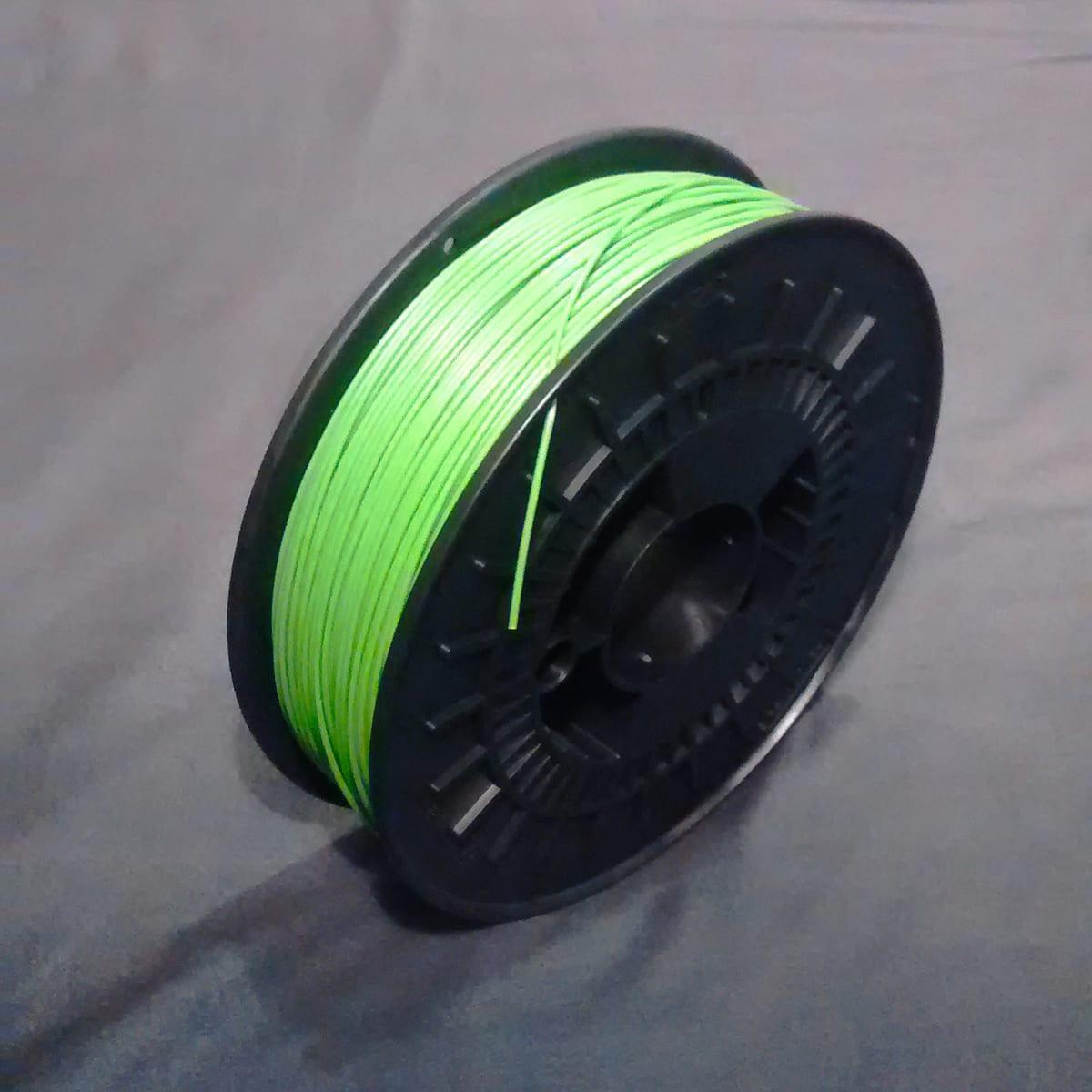
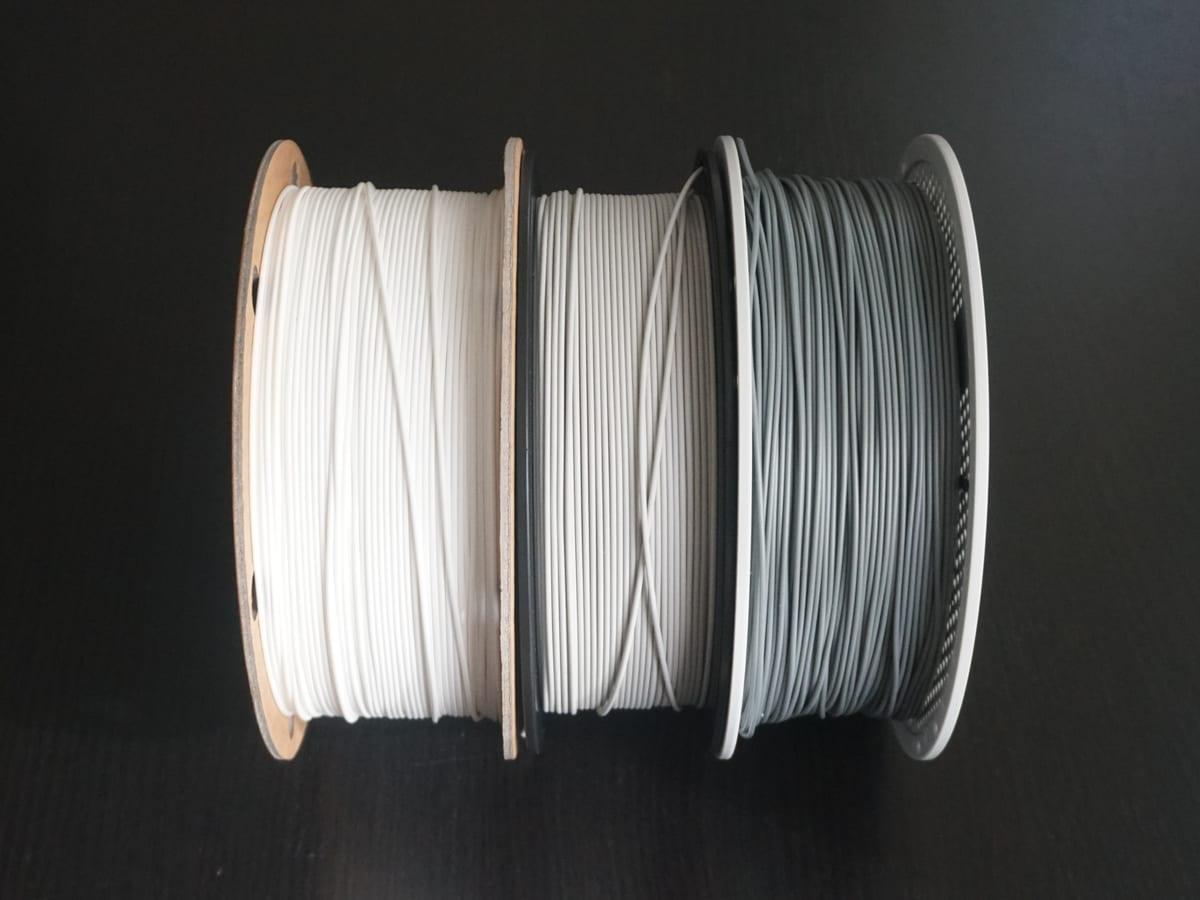
A full "1kg" spool weighs 1.13-1.25kg on a scale, because the advertised kilogram is the plastic only. Empty plastic spools run roughly 150-250g and cardboard spools roughly 130-190g, as of July 2026. If you weigh a part-used spool to work out how much is left, and you forget to subtract the spool, you will think you have 200g more filament than you do and start a 14-hour print you cannot finish.
The fix takes thirty seconds: the next time a spool runs out, weigh the bare spool and write the number on the side in marker. Do that once per brand. Refill spools, which ship as a bare coil with no reel at all, sidestep the problem entirely and usually run $2-4 cheaper per kilogram because you are not paying for a reel you already own.
The Filament You Pay For and Never See
Budget 10-15% more filament than your slicer says. That is the standard waste allowance and it is the same figure our calculator's guidance recommends. It covers five things that are all real and none of which appear in the part weight:
- Prime lines and skirts — 1-3g per plate, every plate.
- Brims and rafts — 5-20g on a large flat part, and you throw all of it away.
- Support material — anywhere from 5% to 80% of part weight depending on orientation. This is the single biggest lever you control.
- Purge on filament changes — trivial on a single-colour print, enormous on a multi-material one.
- Failed prints — a 6-hour print that detaches at hour five has consumed five hours of filament and produced nothing.
The last two are why anybody quoting your job professionally builds a waste factor into the price rather than charging you the slicer number. If a quote looks like it assumed zero failures, it did, and somebody is going to eat the cost of the first one.
Material cost of a 250g print as spool price changes
Moving from a $20 spool to a $40 spool doubles material cost on a 250g print from $5.00 to $10.00 — a $5 swing on a job where machine time is usually $20-60.
| spool | Slicer weight (250g) | With 12% waste (280g) |
|---|---|---|
| $15/kg | $3.75 | $4.2 |
| $20/kg | $5 | $5.6 |
| $25/kg | $6.25 | $7 |
| $30/kg | $7.5 | $8.4 |
| $40/kg | $10 | $11.2 |
| $60/kg | $15 | $16.8 |
Source: Calculated as 250g at the stated spool price, and again at 280g to include a 12% waste factor. 3D Print Bounty cost calculator, July 2026
How Many Grams Does a Print Actually Use?
If you have the model, your slicer answers this exactly and you should trust it over any estimate. If you do not have the model yet, work from volume and density. PLA is 1.24 g/cm³, PETG 1.27, ABS 1.04, TPU 1.21 and nylon 1.14, per published filament manufacturer spec sheets as of July 2026.
A 1kg spool of 1.75mm PLA therefore contains 1,000 ÷ 1.24 = 806 cm³ of plastic. Filament of 1.75mm diameter has a cross-section of 0.0241 cm³ per centimetre of length, so the spool holds about 335 metres. The same kilogram in 2.85mm is only about 126 metres, which is why 2.85mm spools look alarmingly small.
For a real part, the useful shortcut is that a typical FDM print at 15-20% infill and three walls comes out at roughly 25-35% of its solid volume. A 200 cm³ enclosure is therefore around 55 cm³ of plastic, or about 68g in PLA, or $1.70 in material. Feed that gram figure into the cost calculator along with an honest print-hour estimate and you get the number that actually decides whether the project is worth doing.
When Cheap Filament Actually Costs More
The honest answer on premium filament: for most parts it makes no difference, and anyone telling you otherwise is selling filament. A bracket printed from a $20 spool and a $30 spool of the same colour PLA will be indistinguishable in a drawer.
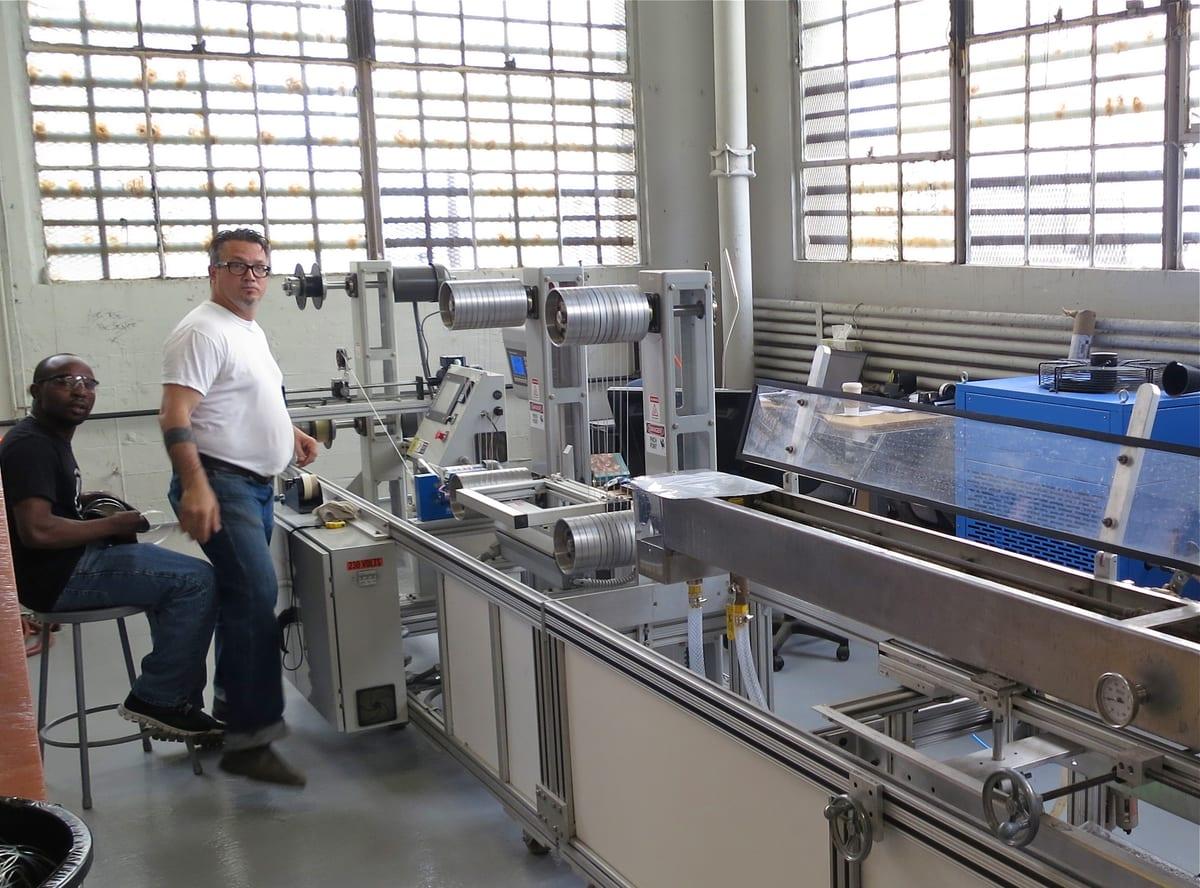
There are three cases where the cheap spool loses money. First, diameter tolerance. Premium spools are held to roughly plus or minus 0.02mm; budget spools to plus or minus 0.05mm. On a 40-hour print, a slug of over-thick filament that jams the extruder at hour 31 costs you 31 hours of machine time, which at $3/hour is $93 to save $10 on a spool. Second, colour consistency: if a job needs two spools of the same colour, buy them in the same batch or accept a visible seam. Third, moisture. Filament that has sat open for a month prints stringy and weak regardless of what it cost, and a $60 dry box saves more money than any spool choice.
Beyond that, buy on price. If you are choosing between two materials rather than two brands, our PLA vs PETG comparison covers where the extra $0.005 per gram is genuinely worth paying.
What Filament Cost Means for a Commissioned Print
Material is typically 5-15% of a commissioned quote. Run a 200g, 10-hour print through the calculator at PLA prices and a mid-range $3/hour machine rate and you get $5.00 of material against $30.00 of machine time: material is 14% of the $35.00 subtotal, and a smaller share still once labour and post-processing land on top.
The practical consequence is that arguing a maker down on filament brand saves you almost nothing, while changing anything that shortens the print saves real money. A coarser layer height, less infill, or an orientation that removes supports can each take hours off. Those are the levers worth negotiating, and they are the ones a good maker will raise before you do.
It also means the material question you should actually ask is not "which is cheapest" but "which one survives what I am doing with it". Paying $0.005 more per gram for PETG on a part that lives in a car is $1 on a 200g print and saves you reprinting the whole thing in August.
Frequently asked questions
How much does 3D printing filament cost per gram?
PLA costs about $0.025 per gram, PETG about $0.030, ABS about $0.028, TPU about $0.045 and nylon about $0.050, based on the default material prices in our cost calculator as of July 2026. Divide any spool price by 1,000 to get your own figure: a $24 one-kilogram spool is $0.024 per gram.
How much filament does a typical 3D print use?
A phone stand uses 60-100g, a dice tower 200-300g, a full-size cosplay helmet 500-800g and a board game insert 300-500g. In PLA at $0.025 per gram that is $1.50-2.50, $5.00-7.50, $12.50-20.00 and $7.50-12.50 of material respectively. Your slicer reports the exact gram figure before you print.
Why is my spool lighter than 1kg when I weigh it?
Because the advertised weight is the plastic only, not the spool. An empty plastic spool weighs roughly 150-250g and a cardboard one 130-190g, so a full 1kg spool weighs 1.13-1.25kg on the scale. Weigh one empty spool of each brand you buy and write the tare weight on it.
Is expensive filament worth it?
Only for diameter consistency and colour matching. Premium PLA at the top of the $19-30 range is held to roughly plus or minus 0.02mm diameter versus plus or minus 0.05mm on budget spools, which matters for fine detail and long unattended prints. For a bracket or a box, a $20 spool prints identically.
What percentage of a 3D printing quote is filament?
Usually 5-15%. On a 200g, 10-hour print quoted through our calculator at $0.025 per gram and $3 per machine hour, material is $5.00 against $30.00 of machine time: 14% of the $35 subtotal, and less again once labour and post-processing land on top. Machine time and labour dominate every quote, which is why print duration matters more than material choice.
Price Your Print in Thirty Seconds
Enter your part weight and print time and the calculator gives you material cost, machine cost and a fair asking price for all six common materials. If you would rather skip the estimate and get real numbers, post the job and let makers bid on it.